Sunday, July 10, 2011

What's in Bloom! (A picture story)

 Mountain Laurel was recently in full bloom at Mount Everett State Reservation, and it gave the trails a lovely fragrance. It's in the laurel family (fitting, right?) along with cranberries and blueberries.

Milkweed has a gorgeous pink bloom.

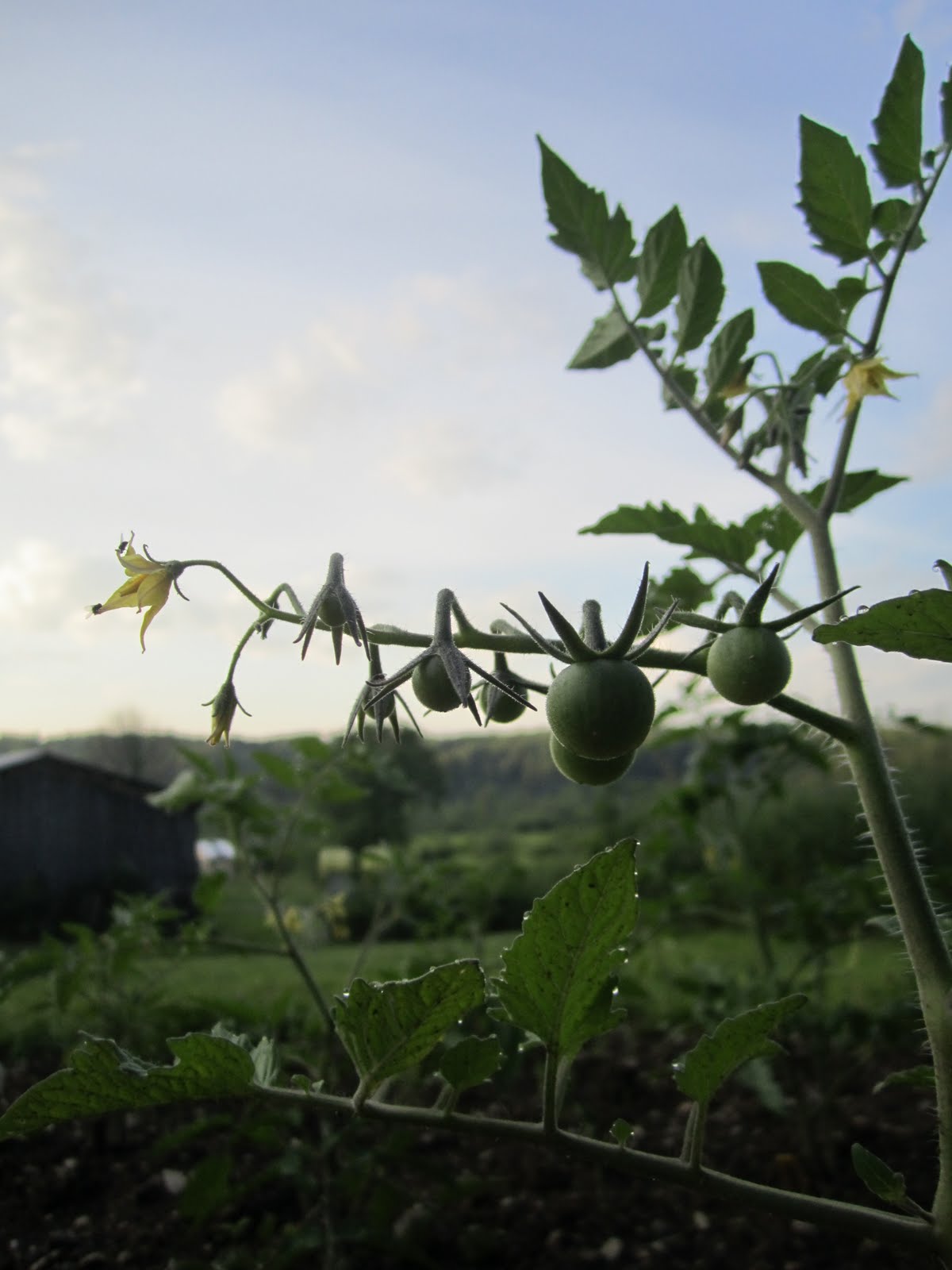
In my garden plot, the tomatoes are flowering. (And if you look closely, there are already some tiny fruits!) I planted this little garden very late in the season, so it's a thrill to see it coming along so nicely. More about that later...

 The part of the broccoli plant that we eat is the flower head. We've been harvesting broccoli for a couple weeks now.

 Snow peas are just about done for the season, but our sugar snaps are still going. 

 Oh, zinnias! Our members picked their first small bouquets this week.

You can't go anywhere around these parts without seeing the bright orange glow of day lilies poking their heads out onto the road. I recently learned that the flower is edible, and it's quite tasty. It would make a beautiful addition to a fresh summer salad.

 We're just about done harvesting garlic scapes, which is what the garlic plant shoots up in the spring. These are the garlic's flower stalks. When they first come up, they curl around and keep growing until the flower bud eventually faces the sky to open up, which is what the one is this picture is getting ready to do. You pick 'em when they're still curled and tender. Pure garlicky goodness. 

 Eggplant has a beautiful purple flower. 

 We haven't yet harvested eggplants for distribution, but as you can see, they're growin'!

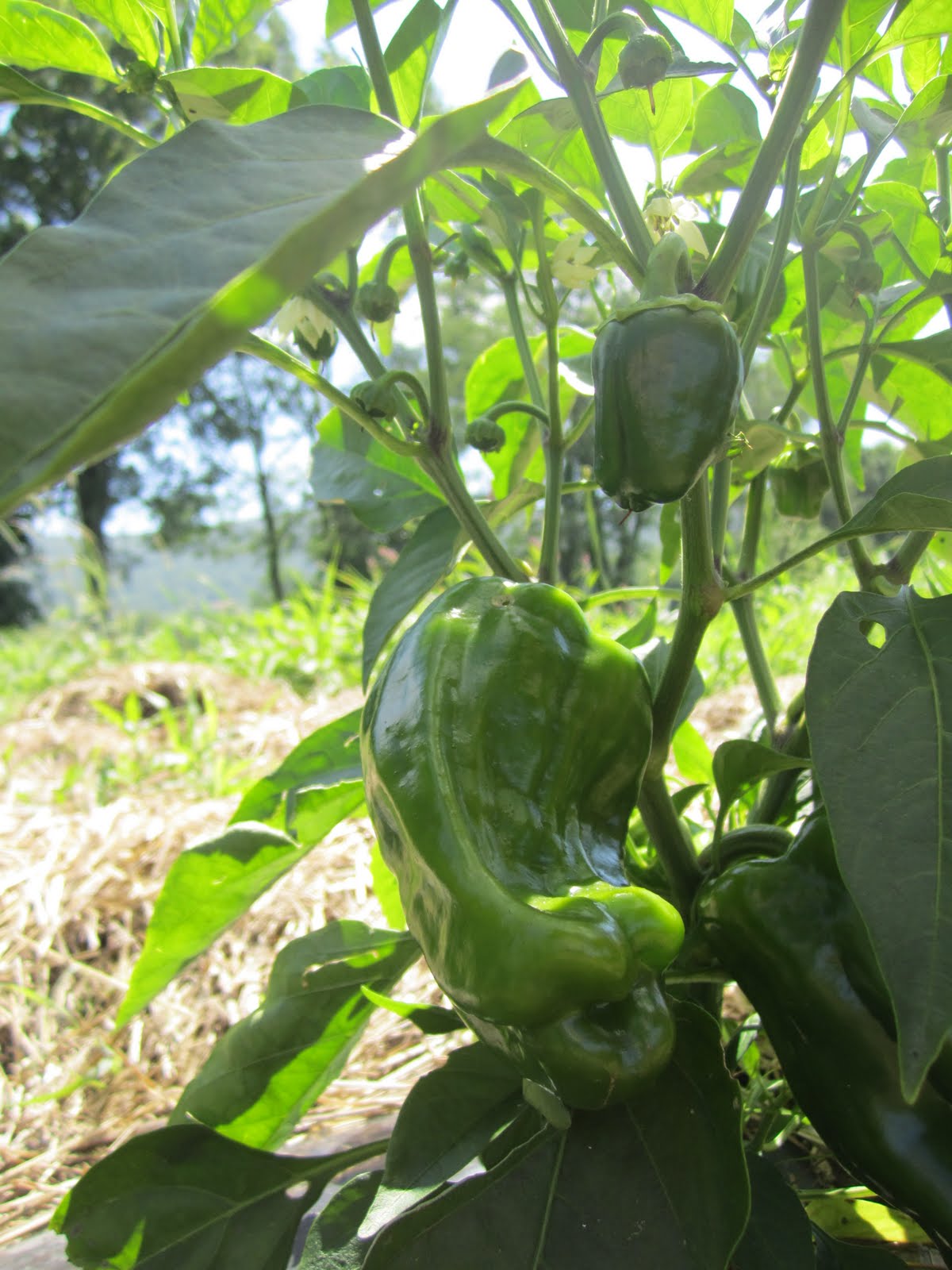
 Same with the peppers. Lots of flowers, lots of maturing fruits, but not quite ready for harvest. They look good though!

 Wild parsnip is also in full bloom. This a weed in the umbel family (apiaceae) which is the same family that carrots, dill, and Queen Anne's lace are in. Wild parsnip is everywhere, and I recently learned that the sap is toxic and can cause a reaction if it touches your skin. Beware of wild parsnip and its relative hogweed. Don't put them in your bouquet!
And of course, summer squash. We've been picking hundreds of pounds a week of yellow squash, patty pan, and zucchini, and the harvest has only just begun! Male blossoms can be picked and eaten, though I have yet to try this out.

It's starting to really feel like summer.

Saturday, July 2, 2011

On Garden Pests and the (un)natural cycle of life

Groundhogs are rodents that belong to the group of ground-squirrels known as marmots. Although they're known to sometimes eat insects and small animals, their diet consists mostly of grasses and (to the dismay of many a farmer and gardener) agricultural crops.

Today, as I drove home from a morning in town, I hit one. It was the first time I had ever hit an animal while driving, and hopefully the last. After I pulled over and managed to get my sobbing under control, I thought about how even though no one, no matter how light their tread may be, can live without affecting the world around them, my impact on the world around me for the day was suddenly much greater than I wanted it to be. Sure, it wasn't my fault that a groundhog had chosen that very moment to dart across the street, but it didn't help me brush off the fact that a life was lost.

As I slowly crept home, still trembling, I thought about where this action -- this karma -- might lead me.

A half an hour later, however, it struck me that this encounter had not been the first time a groundhog -- or the thought of a groundhog -- had forced its way into my day. Earlier in the morning, I had been talking to the owner of a shop in town. After finding out that I worked on a farm, she asked me for advice about protecting her garden from critters like groundhogs and voles. Something, she didn't know what exactly, had been confusing her garden for its own leafy buffet. The kale, she bemoaned... and the peas! All stubs. I told her about the kind of damage we had been finding on the farm (similar to hers, many small plants left as tiny stumps), and the small actions we had been taking, but all in all I wasn't very helpful since I don't know much about deterring garden critters. I told her about how we've been having quite a bit of vole damage to flats of plant-starts in the hardening-off area, but just this week we set out some tables in the hope that raising the flats off the ground will keep the plants safe. This wasn't anything that would help her, but I commiserated with her since she was so visibly frustrated -- venturing into angry -- and we had been frustrated too.

Maybe the groundhog I hit was one that had been feasting on someone's garden. Or maybe my hitting it was meant to remind me that its life was precious. Or maybe it was just an unlucky animal in the middle of the road. Regardless, may it rest in peace.

I still feel deeply sorry. It's small consolation to know that other animals will have full bellies after feasting on an easy road-side meal.

Wednesday, June 15, 2011

Some thoughts...on plant magic, miracles, and religion

I'm pretty biased, in my love of plants, towards new, green growth. Seeds germinating, tender leaves unfurling -- it's all breath-taking. Perhaps I'm just a product of the culture around me in New England, the culture that impatiently awaits the visible re-birth of nature each Spring as the snow melts, the green tips of crocuses push their way up through the frosty earth, and the tree-line becomes dotted with chartreuse.

In any case, I've found myself thinking a bit about my shifting attitude towards the plants we're tending to on the farm. Why is it that I feel less like a caretaker when it comes to the sturdy cabbage plants taking shape and thriving in the field than I did when they were tiny plant-starts in the greenhouse? And does that translate into lesser appreciation? Shouldn't I feel more in awe of their growth now as they take root in the earth and fend (more or less) for themselves? This week I've been awakening to the realization that it is a miracle in its own right to see our formerly fragile seedlings in the fields, growing stronger and larger each day, basking in the nutrients provided by healthy soil. They are beginning to resemble the vegetables they will ultimately provide for us. Which, after all, is the whole point.

You'd think it would be a given for me to appreciate this -- and I do indeed appreciate! It seems like pure magic, a miracle, to plant a seed and later harvest pounds and pounds of fruit. What I feel is a different type of appreciation though -- the first is for the beauty of the plant itself, whereas this other is for the the fact that it gives us food. There's a tension between my desire to see a plant as a beautiful mess of greenery that I partly understand and partly leave up to the whims of Mother Nature, and between the reality that this plant is a cabbage. And that we need the cabbage to eat, more than we need the plant to look at. Eventually, we'll behead this plant.

Although these large vegetable plants are now much less in need of our help in terms of their survival, it's not to say that there's no work to be done. We still have to weed around them to provide ample space for their growth, give them water during a dry-spell, and for some crops, give them an extra helping of nutrients. It is at this stage that it feels less like human hands are in complete control, and more like the whims and guiding hand of something much more powerful. It's at this stage that a farmer has to use everything he or she knows about each crop and various farming methods to make the best decisions. But, there are always twists and turns in the road, and questions that remain unanswered. For example, why are the husk cherries being ravaged by beetles? How can we stop the voles from tunneling under the heirloom tomatoes and chowing down at the base of the plants? How on earth can the radishes get this large and still not split or get pithy? There are always challenges and unexpected gifts.

Needless to say, I am in awe of everything going on at the farm right now. Everything seems miraculous in part because of my inexperience as a farmer, and in part because life is teeming with beauty and energy. This energy is the same life force, prana, that a yogi channels in his or her yoga practice. It's amazing.

When I went to Israel this year, I felt similarly awe-inspired and infused with spirituality. It was an eerie feeling to realize that after thousands of years, after diaspora, after generation upon generation of my family had been praying for Israel, that there I was -- smack-dab in the middle of the holy land. But also striking was Israel's connection to the land.  Not just the political history -- the exhile, the diasporas, the formation of a nation-state, the shifting borders... the connection to land as necesary for religious and political survival. What struck me was the connection between Judaism and agriculture.  The state of Israel and the farming of its precious soil. And how that tied into everything else I just mentioned. It's not surprising that this connection is so strong given the kibbutzniks of the '60s and '70s, and even before that: without a means to provide oneself with food, no Jewish settlement from the 19th century or early 20th century would have survived. Agriculture in Israel is crucial. For a country with so many enemies, with such critical water issues (it's the desert, after all), and with its location making it expensive to import foreign goods, an agricultural system that works and makes good use of the country's resources is a life or death situation. It's no wonder, as I found out while I was there, that Israel is on the cutting edge of sustainable agricultural practices. With such little water, it must be protected and used wisely! With little arable land, soil quality must also be protected and used wisely! (We U.S folks have to adopt these practices on a large-scale too...)

I could go on. But the real reason for my ramblings is because of something I read this week that made me think about farming in Israel in the first place, and connect it to the fact that we're beginning to ramp up our harvest on the farm. I somehow stumbled upon the website of Ganei Beantown, a Boston-based Jewish group focused on food and sustainability issues. In one of their workshop listings, I read that ancient Jewish farmers provided a portion of their harvest for the poor through the practices of Peah, Leket, Shechicha. "Peah," meaning corner, calls for farmers to leave a portion of their harvest, in the corners of the fields, for the poor.  "Leket" refers to gleaning. Produce left in the fields will be left there for others to glean. With "shechicha," produce accidentally forgotten in the fields will be left there for others to glean. Multiple ways to carry out mizvot, some planned, some not planned. Tackling the issues of poverty and food justice from multiple angles. There are numerous other rules relating to agriculture in the Mishna and Tosefta, Jewish Oral Law, as well.

And of course, we have to ask: Why? In asking the question, we are able to learn more about the world, human nature, religion, and ourselves. Why was this done, and how can we translate it to our current food system? Why did ancient farmers do this, and how can we adopt the principles behind it into our own practice of tzedakah? Why were these rules, and not something a farmer could choose to do through his own good will? Everything in Jewish law and literature is fuel for hearty discussion. In the Jewish tradition, you cannot study alone. In fact, you are required to study (and pray) in a group. That in itself is a beautiful thing.

Making sure healthful food is given (or made more accessible) to those in need is obviously not just a Jewish practice, but it makes for an interesting analysis when something like this is Law, religious or otherwise. And I also have to mention that quite a bit of the harvest from the farm I'm apprenticing on goes straight to the local pantry.

For more information on the connections between Judaism and farming, check out Adamah in Connecticut or the Jewish Farm School in New York. I am feeling inspired to learn more about Judiasm, ecology, agriculture, politics, and social justice, and to continue asking: Why?

There are so many ways to farm, and so many philosophies!

Tuesday, June 14, 2011

Everything is falling into place

This past week was a turning point in my apprenticeship. In what felt like a matter of days (but was actually a matter of weeks), we made the shift from plant production to vegetable production.

No longer are we working in the greenhouse all day long. No longer are we planting fast and furiously for the early season crops. No longer are we wondering if nature will be kind to us and turn our hard work into a bountiful harvest. Vegetables? They're here, baby!

This past week was also the first week of our CSA, which meant that individuals and families from the community were driving out to the farm on Tuesday and Friday (our distribution days) and bringing their enthusiasm for fresh vegetables and summertime along with them. CSA stands for Community-Supported Agriculture, which is a way for members of the community to invest in their local farms and, in turn, receive a share of the bounty. This type of arrangement gives the farmers some steady financial ground to stand on at the beginning of the season, and also strengthens the farm's community ties.

For the first CSA distribution, we harvested quite a bit in comparison to the previous weeks' lettuce and radish repertoire. If you're wondering what was in the first week's share, here's the list: (click on the picture to enlarge it)


We also opened the pea section up for members to pick their own:


But as wonderful as it was to be harvesting a variety of vegetables and start up the CSA, the week wasn't without its bumps in the road. After a week of storms, we realized that some of the lettuce had been damaged by hail. It hurt some varieties more than others, and all in all it wasn't horrible. It was most noticeable on the heads of Boston lettuce. On the bright side, the weather plumped up the radishes and -- amazingly -- didn't even cause them to split! The result? Huge (read: gigantic, baseball-sized) radishes that tasted sweet and juicy. Definitely not your average supermarket radish.


We also brought a variety of vegetables to sell at the Saturday Farmer's Market. That large leafy green on the bottom, to the left of the pints of sugar snap peas, is basil. HUGE greenhouse basil, with velvety leaves that have never been exposed to heavy rain (or hail, thank goodness). They love life in the greenhouse!


And perhaps the most exciting of all? TOMATOES! Our greenhouse tomatoes are on the way to red, ripe, juicy deliciousness. Can you spot the red ones in this photo?


Mmmmm tomatoes...

Sunday, June 12, 2011

Peonies

In my family, we accept (and expect) the following to be true:

1. Whenever the dog is groomed, it will rain.

2. Whenever the peonies bloom, it will rain.

While my folks and I might not be the best meteorologists this side of the Mississippi, the peonies outside my home bloomed this week, and not hours before a storm hit the farm with such force -- with all its thunder, lightening, and hail -- that I was let out of work early. While this means that our rule remains steadfast and true, it also means that I have some lazy-looking (but still beautiful) peonies near my front porch. With their chins resting on the wet grass, they look as if they spent all their energy in producing a magnificent bloom, and then proceeded to take a nap. Which, coincidentally, is exactly what I did during the storm.


Sunday, May 29, 2011

Farming is tiring (but oh so satisfying)

The title says it all. This week was hard.

With this week's wave of hot and humid summer weather came a long list of farm chores to keep the new plant growth in check. It suddenly felt like the fields were alive and we had to race against the clock so that everything that needed to go in the ground was in ground, everything that needed to be weeded was weeded, and everything that needed to be trellised was trellised. I keep a journal of everything we do on the farm from day to day, and since this week was particularly interesting (and exhausting), I'm going to share what we did, Monday through Saturday. Here we go!

It started off with a relatively cool Monday, which is the day we planted all the non-tomato nightshades and curcubits in the field. We spent the day planting beds of peppers, eggplant, squash, and cucumbers. We covered the beds with floating row cover and then moved soil bags to hold down the edges of the remay (white fabric that lets light in, keeps heat in, but keeps bugs out). It was so wonderful to look out onto section four at the end of the day and see that every single bed had something growing in it! Four beds of onions, one bed of chard, two beds of peppers, two of eggplant, two of squash, and two of zuccini.

Then came Tuesday. Oh Tuesday, the day of moving soil bags and wooden pallets and wooden stakes. Today was the day we staked the peas. One after the other, row after row, bed by bed. I was told that the soil this year was particularly soft, and that the stakes were easier to drive into the ground. I guess that just means that if this had been last year, I probably wouldn't like peas. But when we went back out into the fields the next day, the pea section looked lovely. Because of the old wood and the trellising, it has an almost "secret garden" kind of feel. I can now visualize what it will be like to walk through the pathways at the height of summer, picking sweet sugar snaps with large pea plants towering over me. It will be beautiful.

On Wednesday I started off making signs for the plant sale we had this Friday, which was pretty successful. After that, we planted all the cherry tomatoes, plum tomatoes, tomatillos, and husk cherries in section two, and then two beds of cutting flowers (sunflowers, zinnias, cosmos, celosia...) in section one. After that...tomato pruning and seeding in the greenhouse.

Thursday was hot and humid. It was even hotter than Wednesday, which was hotter than Tuesday and much hotter than breezy, overcast Monday. On Thursday we made a total transformation of the herb garden from a mess of weeds and fungus and overgrown perennials to a neat garden with 6 distinct small beds. The perennials of the garden are sage, thyme, oregano, lemon balm, and mint. We planted curly parsley, Italian parsley, two types of basil, more oregano, more thyme, more sage, and some cutting celery. Dill and cilantro were direct-seeded.

In the afternoon, everything on the farm that we had been doing for the last month or so really came together for me. In order to cultivate the beds with a tractor, I pulled off the remay from beds in section 5,  3, and 2, and wow! Vegetables! Everything that we had covered after transplanting was healthy and growing, and especially after the tractor went through and got the bulk of the weeds out, the beds looked amazing! To our farm manager, the lettuce heads weren't large enough to harvest, and there is still an elevated level of stress with regard to what will be ready for the CSA. But to my untrained eye and inexperience as a farmer, I was floored to see such greenery that had truly been covered by the remay since we had transplanted the seedlings. It looked like....like... a farm!

On Friday, we harvested spinach and radishes, then washed and boxed them for the farmer's market the following day. After a variety of small tasks in the greenhouses (switching the drip, watering) and in the fields (fixing the remay in section #1, using a scuffle hoe in section #2), I staffed the plant sale for a couple hours. Before I quit for the day, I weeded the perennial border near the barn so that we have room to plant some annuals next week.

Saturday, 6:45 am. We load the truck for the farmer's market and head off. I drive the truck with the plants. After we unload, myself and another farm worker drive back to the farm and load up with more plants. At the farmer's market, I talk to customers, keep the plants stocked, and ring people up. There were three of us all together, so two could sell plants and one could sell the spinach and radishes. At 1:00, we packed up, drove back to the farm, and unloaded.

And then on the seventh day, we rested. :)

Except for part of the day, I didn't. After a nice relaxing morning-- I took a jog and then went to a yoga class in town -- I measured out a ten by ten plot of land near where I'm staying on the farm. It's been wonderful to learn so much about growing vegetables while working on someone else's farm, but I've been itching to grow my own too. Not that I can't eat what's grown in the fields, but there's something special about just tending to a handful of your own plants to feed yourself during the growing season. Some peppers, tomatoes, kale...and okra! So I outlined the plot and started to rip up the sod with a digging fork. (But when I got tired, I stopped. It's Sunday for goodness sake!) I also sowed some okra seeds in a 6-pack in the greenhouse. I bought a package of "clemson spineless" okra seeds at the natural foods store in town. If this heat and humidity is any indication of what is to come for the rest of the summer, I think the okra will do just fine.

My intent is that this small garden plot will give me a little relief and relaxation during the course of the growing season. Because when you're working on the farm and you need to transplant hundreds of seedlings in an afternoon, you can't tenderly place each one into the ground before moving onto the next. And when you're getting paid by the hour, you can't leisurely remove weeds, observing the tiny hairs on the stinging nettle and admiring the diversity of weeds that so quickly took up space where you just so happen to want to plant tomatoes. It's not that I don't enjoy the farming, but the approach to vegetable growing in a garden (versus a farm) is very different, and I'm beginning to miss some aspects of gardening's smallness. In my garden plot, at the end of the day, I will have all the time in the world to admire my plants.

I look forward to it.

Tuesday, May 24, 2011

Lilacs in bloom

Lilacs are in full bloom here in the Berkshires. In Boston, these gorgeous, aromatic blooms were strutting their stuff two weeks ago when I was home for Mother's Day. My parents and I strolled around the Arnold Arboretum with the newest addition to the family -- Cassie the poodle -- during the Arboretum's celebration of Spring and lilacs: Lilac Sunday. Below are some photos I've been meaning to share.


Monday, May 23, 2011

Farm update, in photos

I took these photos nearly two weeks ago now, on one of those rare, sunny days we've been having. It's been a slow spring so far since the weather has been mostly overcast, cool, and rainy. Many of the direct-seeded spring crops have had poor germination rates, and those that made it have been slow to grow. We just harvested our first spring crop this past Friday - French Breakfast Radishes - and even those could have been a bit bigger had we waited another week.

Since I took these photographs though, we've had enough dry days to plant all the brassicas, another round of lettuces, the celeriac, the leeks... and today we were lucky to be able to plant all the peppers (bell, sweet, and hot), all the eggplants, the squashes, and the cucumbers. Now we just need some warm sunny days to get these plants revved up for summer!

Here are the pictures I took in the second week of May. Much has changed since then, but I think the photos are pretty enough to post. Enjoy!

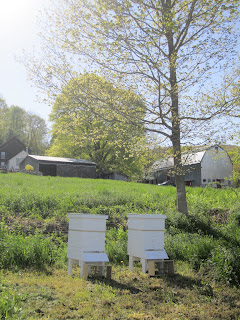
 A local beekeeper recently placed two hives on the farm. 
 The large greenhouses, from right to left, are #1 and #2. Notice the metal frame all the way to the left in the photo? That's a greenhouse too. Since this photo was taken, we dug up all the weeds, sod, and left-over black plastic from this greenhouse, turned under the beds with compost, and planted herbs and heirloom tomatoes. We secured a large sheet of  plastic to the frame to create the greenhouse effect and keep the plants toasty. Although the tomatoes are inside and planted on black plastic, we still covered them with floating row cover to insulate them even more.

The heirloom tomatoes, basil, and flowers of Greenhouse #2.

 Section #1 in the field. The closest bed in the picture holds the scallions. Since this photo was taken, this section has been filled with leeks, brussel sprouts, cabbage, broccoli, cauliflower, kale, and celeriac. 


Hot house tomatoes in Greenhouse #1.  These babies should be ripe in June!

 Plant starts for sale. We sold lots of plants at the farmer's market this Saturday.

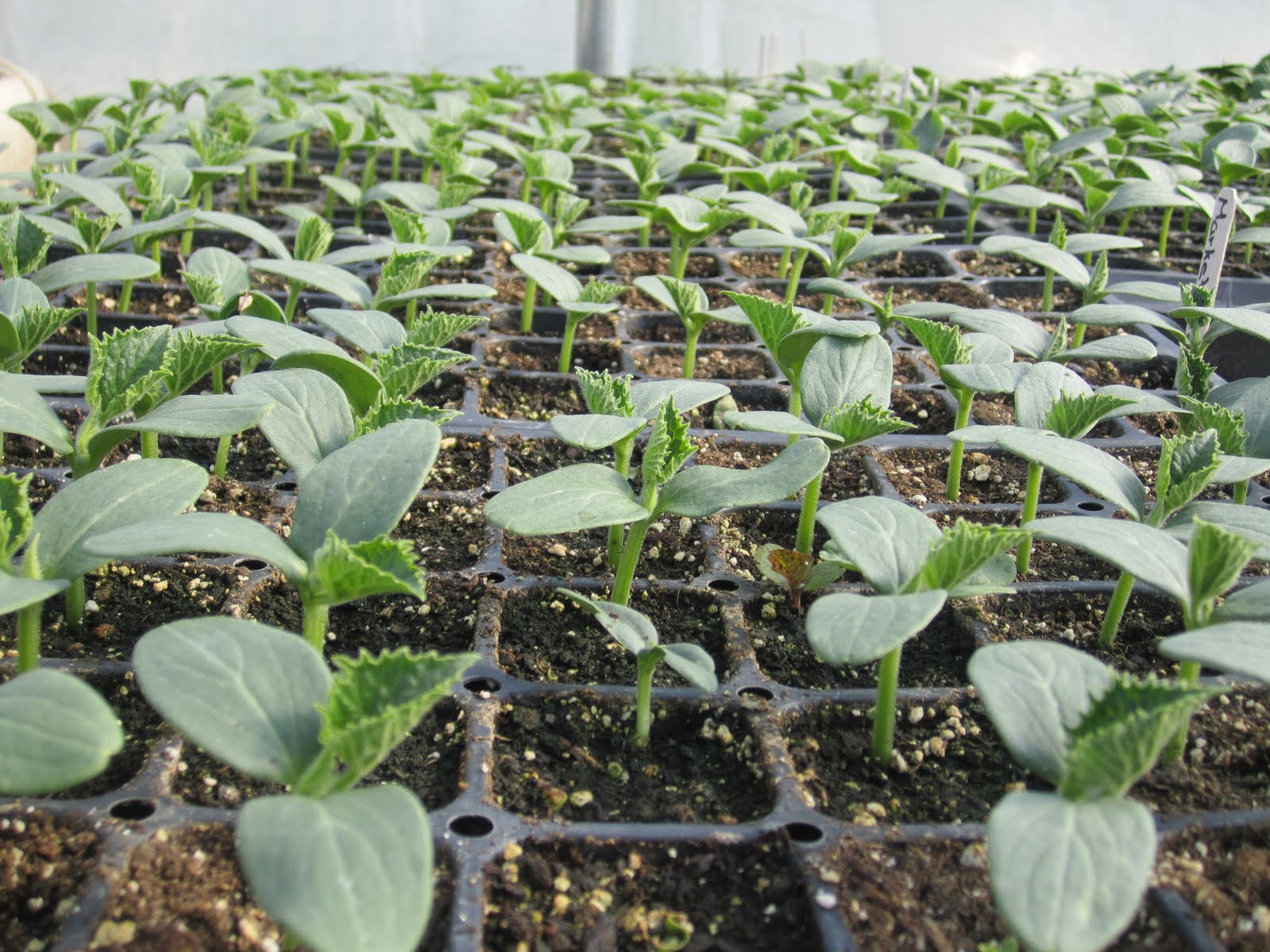
 Aww, look at those baby cucumbers. Aren't they cute?


Violets are growing wild on the hill near the farmhouse. Such a treat to have gorgeous flowers on the farm that we didn't even have to plant!

Sunday, May 15, 2011

Honeybees and sustainable agriculture

Last Friday I drove over the state-line to go to a film screening of Queen of the Sun at Hawthorne Valley Farm. The film takes a look at the state of honeybees in the U.S and beyond -- anywhere that ecologically balanced systems are being ravaged by large-scale industrial agriculture. It treats the issue of Colony Collapse Disorder not with shock or surprise, but with sadness, understanding, and urgency. With all that we expect from bees for our food production in our agricultural system, of course there's a problem. Extensive monoculture, pesticides, genetic modification -- not to mention the way bee hives themselves are cared for and trucked around on an industrial scale -- it's no wonder the bees are dying!

Take the pollination of almonds, for example. Honeybees are trucked in from all over the United States during the pollination season on California almond orchards. Because bees from many regions of the country are brought together (all together), it gives them the opportunity to share infections - from mites to viruses. And when the U.S bees weren't even enough to do the job, the U.S granted permission to import honeybees from New Zealand. These bees brought with them foreign diseases such as the Israeli Acute Paralysis Virus. Cue increasing honeybee health problems in the U.S. The industrial hive caretakers interviewed (albeit briefly) in the film stated that they don't do what they do for any other reason to make a living. They have to travel the distances, truck their bees around, and feed them what they do because that is what our industrial system calls for.

(What are hives fed when they're getting started? High fructose corn syrup. Oh, the irony of having producers of the most naturally delicious sweet-stuff on earth consuming one of our sweet industrial poisons!)

The bottom line here is that there aren't enough economic incentives to take care of our land and pollinators (and water and seed stock and farm workers....etc.) to change our industrial food system into something socially and ecologically conscious. We are biting the hand that feeds us, and it's biting back.We have to change out ways. Buying conventional vegetables at the supermarket supports the petrochemical industry and Monsanto more than it supports the future of our health and environment. I often find it totally overwhelming, and I end up getting flustered when I go to a mainstream supermarket instead of a natural foods co-op or Whole Foods. Some simple ways to change the agricultural system in the U.S are to buy local, organic and/or naturally grown food from small-scale and family farms. If we shift our mindsets to make it a priority over buying the newest hippest technological gadgets out there, it might be possible to find an extra few dollars each shopping trip to make the shift over to purchasing sustainably-grown veggies.

But there are so many practices and questions that make my head spin. For example, should I stop eating almonds (even organic almonds)? If my focus is on local and sustainable, shouldn't I get my protein from animals and their by-products rather than trucked-in nuts and legumes from large-scale agricultural enterprises (even if they're organic)?

I've been thinking about and questioning the practices of animal agriculture a lot lately. I had visited Hawthorne Valley Farm for a tour of their dairy the week before I came back for the film, as part of the Northeast CRAFT program. As someone who has leaned towards a vegan diet more or less over the last three years, I came into the tour wary of livestock and grazing practices no matter how sustainable they might be. I was hoping to be blown away -- perhaps to see that the dairy cows were being treated like queens and that I could now eat all the cheese and yogurt I had ever craved! To a pretty large degree, I was impressed with their dairy. Calves are kept with their mothers and weaned after 16 weeks (compared to industrial systems in which calves are ripped from their mothers soon after birth). Cows are milked in the morning and the calves are then able to nurse for the better part of the day. The somatic cell count of the milk is under 100,000-200,000 cells per milliliter (excellent quality) versus industrial milk's upper limit of 1,000,000 cells per milliliter. The connection between the dairy and meat industries (male calves are auctioned off because of feed and pasture limits), the waste issue (although composted manure is great for vegetable agriculture), and the housing issue (old barns where cows spend more time in the winter often don't have the space or air-flow for optimal health, and cows must be secured in some way to their stall for their safety so they don't fall or get stuck somewhere) still bother me, however.

If I had a veggie farm with extra acreage for grazing animals, would I buy a cow or two to milk? I don't think so. But on a scale from industrial/inhumane to sustainable/conscientious, I'm finding it easier to branch out and eat animal by-products knowing that I'm able to support some of the small-scale farms that actually do care for their animals and the nutrition of their products. Again though, I don't want to assume that owners of and workers on industrial animal farms have no feeling of responsibility for the food they produce. It's not a battle of the cold-hearted versus the loving. As a nation, we need our policies and our mindsets to change. Right now.

Thursday, May 5, 2011

Roy Boutard Day

This past Sunday, May 1st, was the grand opening of the Berkshire Botanic Garden for the 2011 season. Given that it was a beautifully sunny day, that I love botanical gardens, and that the event was free, I zig-zagged my way from South Egremont to West Stockbridge to see what all the fuss was about.

The fuss, it appears, was not only about the elegant and delightful gardens that are patiently awaiting their gardeners' vision for the Spring, but also about Roy Boutard, who led the Botanic Garden as its Director for an impressive thirty years. Roy Boutard shaped the lanscape and culture of the Botanic Garden from 1954 to 1984. After his death this past year, the Garden resolved to name each Spring Opening Day in his honor, such that his vision and incredible commitment to the Garden could live on and be remembered.

I never met Roy Boutard, but after the tour I took through the gardens with horticulturist David Burdick, I felt as if I understood just how significant a person he was to the garden, and how his infectious enthusiasm for plants lives on today through his colleagues. According to Burdick, Boutard lived by the philosophy that you can never have enough plants  - you can never have enough varieties, enough plantings, or enough new material to introduce to the gardens. Burdick took us around the grounds and pointed out areas that changed under Boutard's direction, as well as specific plantings that were significant to Boutard's career and vision. For example, a dense stand of conifers that Boutard planted when they were "kittens," as he had called them, had matured into "cats" and had been relocated throughout the grounds. In fact, everywhere you looked you could see a beautiful mature conifer from Boutard's original planting when they were mere saplings.

If anything, Burdick's talk about Roy Boutard's career with the Berkshire Botanic Garden inspired me to think about what's possible if you commit not only to the idea of a garden (or to any goal that one can pursue passionately), but to following its whims and meanderings to "completion." Just like with the farm work I'm doing now -- or any task anyone ever does, for that matter -- one step at a time will get you there. Realizing that an entire bed needs to be ripped up, fertilized, turned under, raked, planted, irrigated, covered...etc. can be utterly exhausting. But there is beauty in taking a deep breath and jumping whole-heartedly into each task. Once it's done (for the moment at least), it will feel glorious.

The colors, textures, and smells of the Berkshire Botanic Garden were inspiring in and of themselves:


Daffodil hill
 

  Hellabora in bloom


Brilliant forsythia


 Tulips - quaint New England style


Magnolia blossom


Our tour through the garden